Why Saying “I’m So OCD” Can Be Offensive
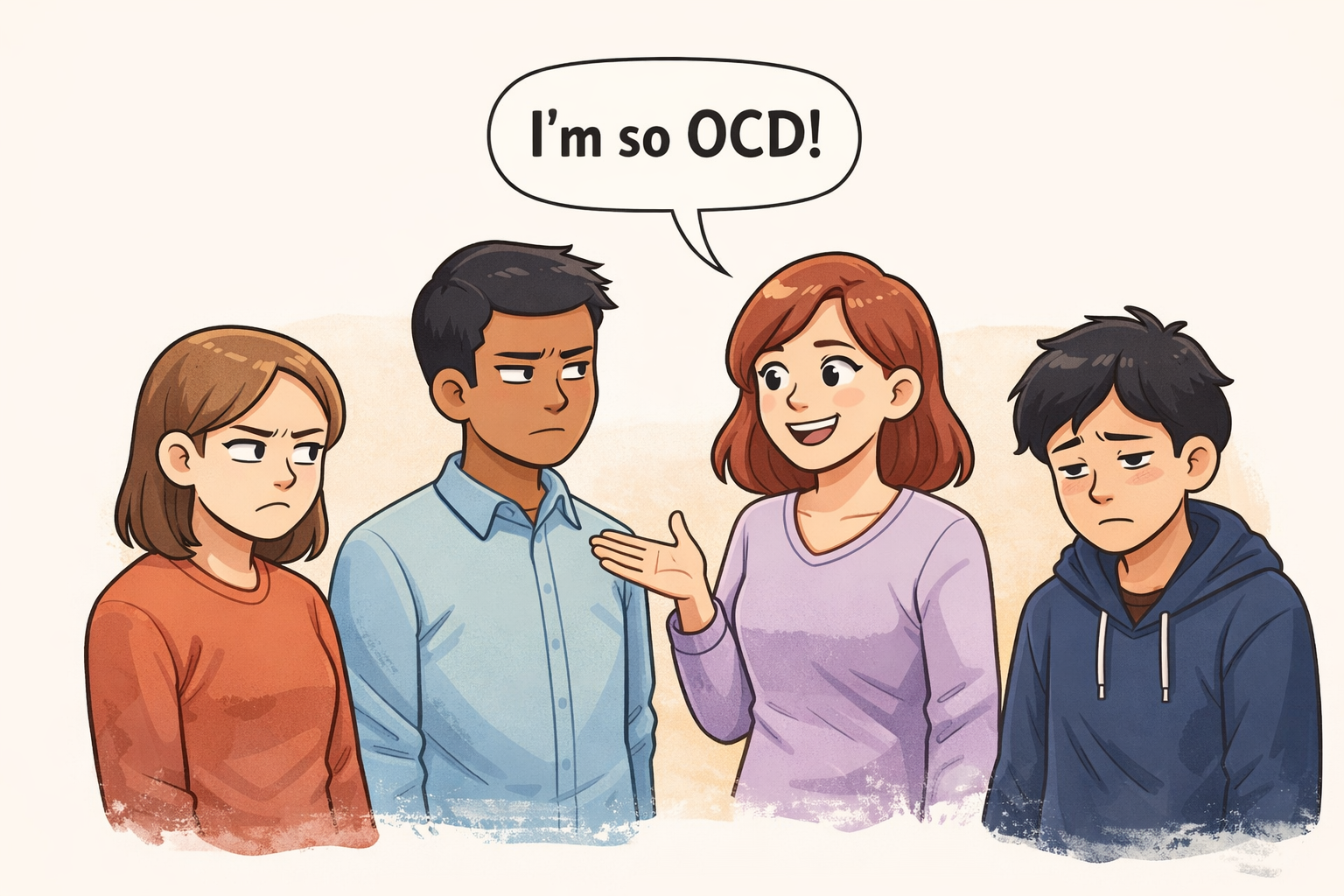
It’s something many of us have heard, or said:
“I’m so OCD about my desk.”
“I need my kitchen organised. I’m a bit OCD.”
It’s usually intended as shorthand for being tidy, detail-oriented, or perfectionistic. But clinically, Obsessive-Compulsive Disorder (OCD) is something very different. Research continues to show that it is a complex, impairing, and often misunderstood condition.
Using “OCD” casually doesn’t just stretch the definition. It risks minimising a disorder associated with significant psychological distress, functional impairment, and measurable neurobiological differences.
Let’s unpack what OCD actually is, and why language matters.
OCD Is a Clinical Disorder, Not a Preference for Order
OCD is characterised by obsessions and compulsions.
Obsessions are intrusive, unwanted thoughts, images, or urges that cause marked anxiety. Examples include intrusive fears of harming others, contamination concerns, religious or moral scrupulosity, and many others.
Compulsions are repetitive behaviours or mental rituals performed to reduce distress or prevent a feared outcome. This may involve repetitive checking behaviours, reassurance seeking, or mental rituals that consume hours each day.
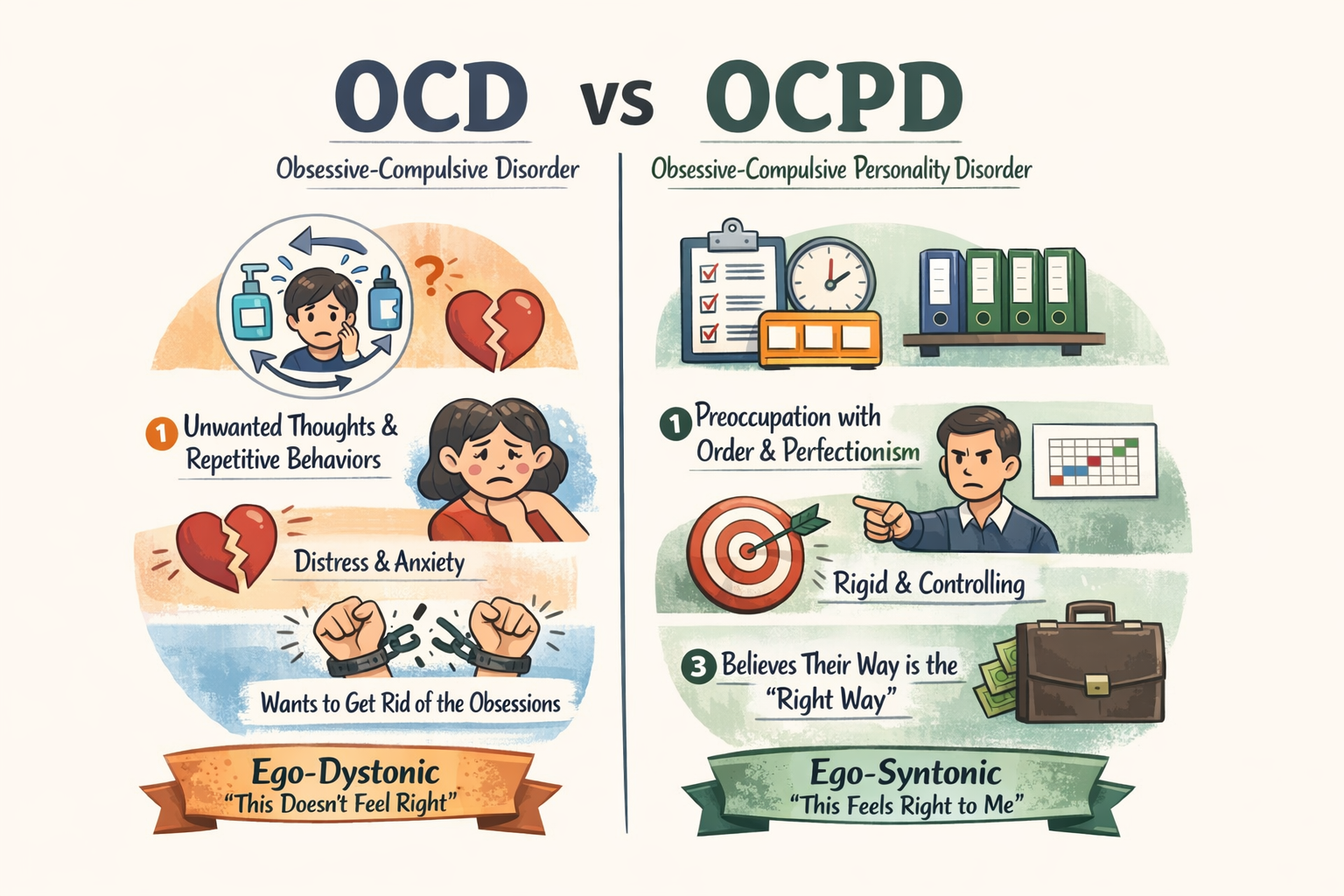
Globally, OCD affects approximately 2–3% of the population and is associated with substantial impairment (Zhang et al., 2025). OCD is not simply a personality quirk or a fondness for symmetry. Research shows that OCD symptoms are often ego-dystonic, meaning they feel intrusive and inconsistent with the person’s values (Zhang et al., 2025).
That is very different from enjoying a clean workspace.
Then There Is Obsessive-Compulsive Personality Disorder (OCPD)
Obsessive-Compulsive Personality Disorder (OCPD) is a personality disorder characterised by a pervasive pattern of perfectionism, rigidity, excessive need for control, and preoccupation with orderliness that begins by early adulthood and is present across multiple areas of life.
Unlike OCD, OCPD does not centre on intrusive thoughts and anxiety-driven rituals. Instead, it reflects enduring personality traits that shape how a person thinks, relates, and functions.
Individuals with OCPD commonly exhibit:
Excessive perfectionism that interferes with task completion
Preoccupation with rules, lists, schedules, and details
Over-devotion to work at the expense of leisure or relationships
Reluctance to delegate unless others do things “their way”
Rigidity and stubbornness
Inflexibility around morals, ethics, or values
Difficulty discarding worn-out or worthless objects
Financial over-control or miserliness
These patterns are typically ego-syntonic, meaning they feel consistent with the person’s identity. The individual often sees their standards as correct or necessary, even when those standards create relational or occupational strain.
OCPD is one of the most common personality disorders in both community and clinical samples. In clinical populations, particularly among individuals with OCD, prevalence rates can be significantly elevated (Dondu & Sevincok, 2025; Zhang et al., 2025).
Importantly, OCD and OCPD are different conditions.
OCD involves intrusive, unwanted thoughts and anxiety-driven compulsions.
OCPD involves rigid personality traits centred on control and perfectionism.
Although they can co-occur, they are separate diagnoses with different treatment implications.
What It Actually Looks Like
OCD is like this:
You’re about to leave the house and suddenly a thought hits you: “What if I left the stove on and the house burns down?” You checked it already. Twice. But the anxiety spikes anyway. Your heart races. You can’t focus. So, you go back and check again. And again. Maybe you take a photo for reassurance.
You don’t want to keep checking. You know it probably doesn’t make sense. But the fear feels unbearable unless you perform the ritual.
That’s OCD.
It’s driven by intrusive, distressing thoughts, and behaviours performed to relieve that anxiety.
OCPD is like this:
You’re working on a report.
You rewrite the introduction five times because it’s not “perfect.” You spend 40 minutes adjusting formatting. You refuse to delegate because no one else will do it “properly.” You’re proud of your high standards. But deadlines get missed. Colleagues feel micromanaged. You feel tense when things aren’t done your way.
There’s no intrusive fear. No sudden spike of catastrophic anxiety. It’s a rigid belief that things must be done correctly, your way.
That’s OCPD. It’s driven by perfectionism and control, not intrusive obsession.
Why Saying “I’m So OCD” Can Be Offensive
OCD is a mental health disorder involving intrusive, distressing thoughts and repetitive behaviours performed to reduce intense anxiety. For many people, it can be exhausting, time-consuming, and deeply impairing.
Reducing that to “I like my desk tidy” diminishes a clinically significant condition into a personality preference.
For someone living with intrusive fears about harming a loved one, contamination, or moral failure, that comparison can feel dismissive.
Equating OCD with tidiness also reinforces a narrow stereotype. Many forms of OCD are invisible. When we collapse the condition into “being organised,” we make it harder for people with less visible presentations to be recognised and taken seriously.
What most people mean when they say “I’m so OCD” actually aligns more closely with perfectionism or obsessive-compulsive personality traits, not OCD itself. Conflating the two contributes to public misunderstanding of both conditions.
For someone whose life is ruled by unwanted thoughts and anxiety-driven rituals, or whose rigid personality traits create daily strain, hearing their diagnosis used casually can feel trivialising.
Language Shapes Mental Health Literacy
How we speak about mental health influences stigma, help-seeking, public understanding, policy, and funding priorities.
Precision in language signals that mental health conditions are real, complex, and deserving of respect.
So next time you think of saying, “I’m so OCD,” try saying what you actually mean:
“I like things neat.”
“I’m detail-oriented.”
“I’m a perfectionist.”
It’s a small shift, but small shifts contribute to a more informed and compassionate conversation around mental health.
For more information read:
Dondu, A., & Sevincok, L. (2025). Clinical characteristics of obsessive-compulsive disorder comorbid with obsessive-compulsive personality disorder: Subtype implications. Frontiers in Psychiatry, 16, Article 1577042. https://doi.org/10.3389/fpsyt.2025.1577042
Zhang, C., Zhang, Z., Gao, R., Chen, Y., Cao, X., Yi, X., & Fan, Q. (2025). Obsessive-compulsive disorder comorbid with or without obsessive-compulsive personality disorder: Conceptual implications, clinical correlates, and brain morphometries. Biological Psychiatry: Cognitive Neuroscience and Neuroimaging, 10(12), 1276–1283. https://doi.org/10.1016/j.bpsc.2024.09.010