Periods, the Brain, and Mood: What’s Really Going On?
Source: Generated with AI
Most of us have heard the usual comments about periods: “She’s hormonal,” “It’s just PMS,” or “You’re overreacting.” Some of us even say it to ourselves.
These comments are not only unhelpful, but they are also misleading.
Yes, the menstrual cycle can affect how someone feels. It can influence energy, sleep, pain, mood, focus, and emotional sensitivity. But that does not mean people become irrational, weak, or unable to cope.
A better way to understand the menstrual cycle is this: throughout the month, the body’s internal environment changes. Hormones rise and fall. The brain responds. The nervous system responds. The body may feel different at different points in the cycle (Farage et al., 2008; Le et al., 2020).
That does not make someone “less capable.” It simply means the body is doing a lot.
What are estrogen and progesterone?
Estrogen and progesterone are hormones. Hormones are chemical messengers that help different parts of the body communicate.
Estrogen usually rises in the first half of the menstrual cycle and peaks around ovulation. Ovulation is when an egg is released from the ovary. Estrogen helps build the lining of the uterus, but it also plays a role in the brain and has been linked with memory, mood, energy, and emotional wellbeing (Farage et al., 2008; Pletzer et al., 2019).
Progesterone rises after ovulation, during the second half of the cycle. Its job is to help prepare the body in case pregnancy happens. Progesterone can also affect sleep, body temperature, appetite, pain sensitivity, and brain activity (Farage et al., 2008; Le et al., 2020).
A simple way to understand the cycle is:
Estrogen rises before ovulation.
Progesterone rises after ovulation.
Both hormones drop before the next period begins.
That drop may be one reason some people feel more tired, low, emotional, or physically uncomfortable before or during their period (Farage et al., 2008; Shuster et al., 2023).
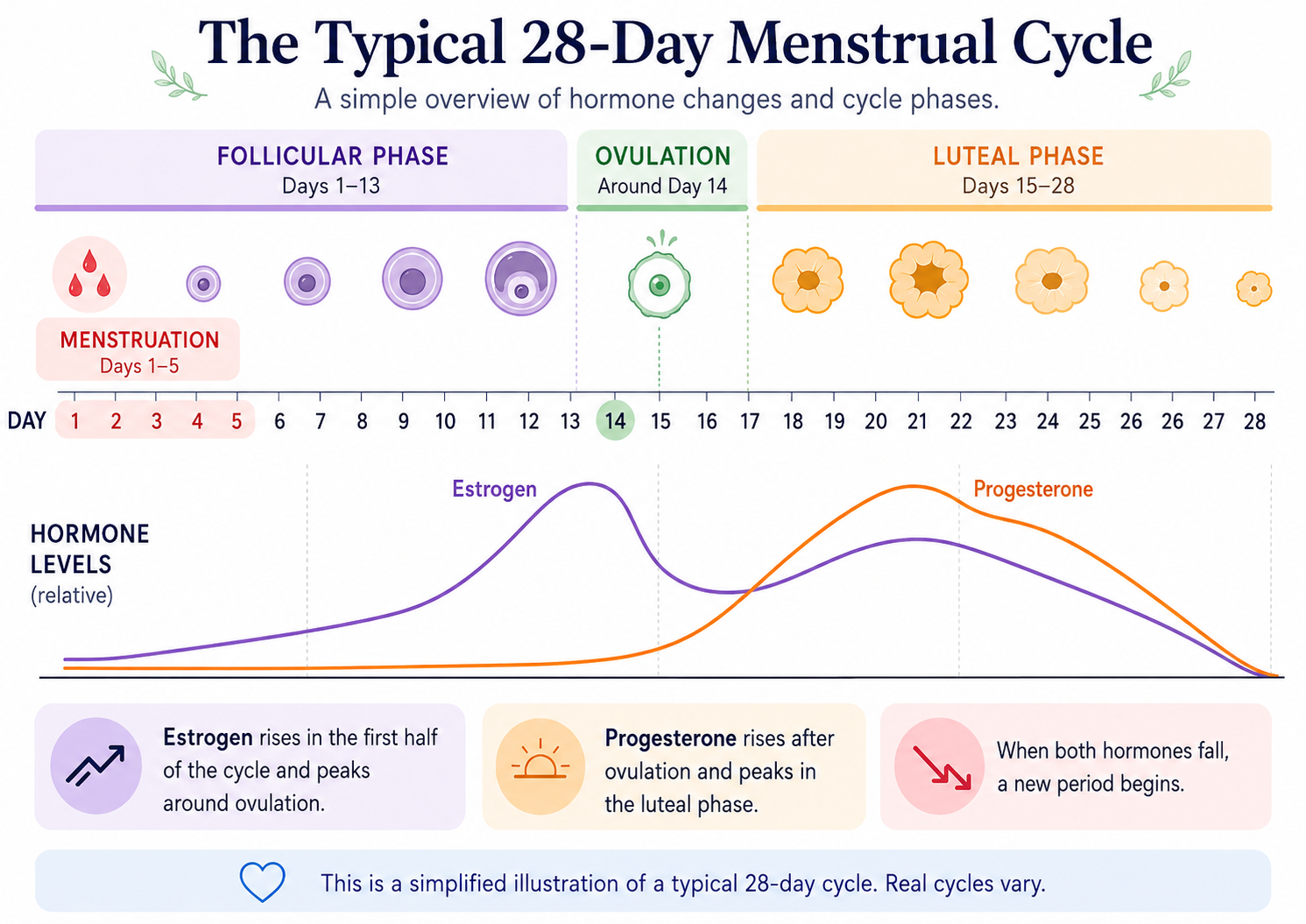
Figure 1. A simplified overview of hormone changes across a typical 28-day menstrual cycle. Real cycles vary.
First, what happens in the brain during a period?
A period is not just something happening in the uterus. The brain is involved too.
During menstruation, estrogen and progesterone are low. These are two key hormones that help regulate the menstrual cycle. They also interact with areas of the brain involved in mood, memory, stress, pain, and emotional processing (Farage et al., 2008; Le et al., 2020).
Research suggests that the brain can show different patterns of activity across the menstrual cycle, including in areas linked with memory, emotion, pain, and stress (Jang et al., 2025; Pletzer et al., 2019). This does not mean the brain stops working properly during a period. It means the brain is responding to a changing hormonal environment.
One study found that during menses, the body’s usual morning cortisol response was flatter. Cortisol is often called a stress hormone. The same study also found that pain perception was highest during menses (Ozgocer et al., 2017). In plain English, this suggests that during a period, the body may process stress and pain differently.
So, if someone feels more tired, sore, sensitive, or easily overwhelmed during their period, it is not “all in their head.” The brain and body are genuinely working under different conditions.
Does your brain work less well during your period?
This is where we need to be careful.
Some people do feel foggy, tired, distracted, or less sharp before or during their period. That experience is real. Pain, poor sleep, cramps, low energy, and stress can absolutely make it harder to concentrate. But research does not support the idea that people become less intelligent or less capable during their menstrual cycle (Jang et al., 2025; Le et al., 2020).
A large review of studies looked at attention, memory, creativity, problem-solving, verbal ability, spatial ability, motor skills, and other types of cognitive performance (Jang et al., 2025). Overall, it did not find strong evidence that cognitive ability reliably changes across the menstrual cycle. In simple terms: you may feel different, but that does not mean your brain is failing.
This distinction matters.
Feeling foggy is valid. Feeling tired is valid. Struggling to focus while in pain is valid. But it does not mean someone is less competent, less rational, or less able to make good decisions.
A period is not a performance defect.
What about focus, memory, and mental energy?
Focus can be affected by many things: sleep, pain, stress, food, workload, emotions, and hormones.
So, when someone says, “I cannot focus today, I’m on my period,” that may be true for them. But the reason may not be that the menstrual cycle directly reduces intelligence or memory. It may be that the body is dealing with pain, fatigue, poor sleep, or emotional strain (Jang et al., 2025; Shuster et al., 2023).
Think of it like running too many apps on your phone. The phone still works, but the battery drains faster.
During some parts of the cycle, especially before and during a period, some people may have less emotional or physical battery. They can still think clearly, but it may take more effort.
What about strength and exercise?
The research on exercise and the menstrual cycle is mixed.
Some people feel stronger or more energetic at certain points in their cycle. Others notice no difference. Some find that workouts feel harder before or during their period, especially if they have cramps, heavy bleeding, headaches, bloating, or poor sleep.
Research so far does not give one simple rule like “everyone should train this way during this phase.” Bodies vary too much for that.
One small study on recreational runners found that both a menstrual-cycle-adapted training plan and a traditional training plan improved aerobic fitness, but the cycle-adapted plan did not show extra benefits for recovery or premenstrual symptoms in that sample (Kubica et al., 2023).
What does seem clear is that pain and fatigue matter (Ozgocer et al., 2017; Shuster et al., 2023). If someone is in pain, their performance may feel worse. If sleep is poor, recovery may feel harder. If bleeding is heavy, energy may drop
So, the most practical approach is body awareness, not rigid cycle rules.
Some people may benefit from gentler movement during painful days. Others may feel better after exercise. Some may want rest. Some may want routine.
The body gets a vote.
Sleep might be one of the biggest factors
Sleep is a huge part of the period and mood conversation.
One study found that being on your period did not automatically lower mood. But sleep quality changed the picture (Shuster et al., 2023). After a good night’s sleep, mood was similar during menses and non-menses days. But after a poor night’s sleep, positive mood was lower during menses (Shuster et al., 2023).
That is a really helpful finding. It suggests that a period may not automatically cause low mood. But a period plus poor sleep can make things harder (Shuster et al., 2023).
This makes sense in real life. When you are already uncomfortable, sore, or low on energy, bad sleep can make your emotional buffer much thinner.
So instead of only asking, “Are my hormones affecting me?” it may help to ask:
“How did I sleep?”
“Am I in pain?”
“Have I eaten enough?”
“Am I overloaded?”
“Do I need rest, support, or a slower pace today?”
What does research say about mood?
Mood changes across the cycle are real for many people, but they are not the same for everyone.
Some people notice low mood, irritability, anxiety, tearfulness, or sensitivity before their period. Some feel worse during the first few days of bleeding. Some feel their best around ovulation. Some barely notice emotional changes at all.
Research often finds that when mood changes happen, they are more likely to appear before or during menstruation, when estrogen and progesterone are low or falling (Farage et al., 2008; Shuster et al., 2023). But mood is not just hormones.
Mood is also affected by sleep, pain, stress, relationships, workload, trauma history, mental health, diet, exercise, and whether someone feels supported.
One study found that positive mood was highest around ovulation and lowest during menses (Pletzer & Noachtar, 2023).
Other research suggests that people may feel different across the cycle even when their objective thinking skills stay stable (Jang et al., 2025; Le et al., 2020).
So, the real message is not “periods make people moody.”
The real message is the menstrual cycle can change the body’s emotional bandwidth.
Emotional bandwidth is the key idea
Emotional bandwidth means how much stress, discomfort, noise, pressure, and emotional demand you can handle before things feel too much.
Before or during a period, some people may have less bandwidth.
That does not mean their feelings are fake.
It does not mean they are overreacting.
It does not mean they are irrational.
It may mean their body is already carrying more than usual.
Cramps take bandwidth.
Poor sleep takes bandwidth.
Heavy bleeding takes bandwidth.
Bloating takes bandwidth.
Headaches take bandwidth.
Having to pretend everything is fine takes bandwidth too.
So, if a small problem feels bigger during your period, it may not be because you are “too emotional.” It may be because your system has less spare capacity.
Why the stereotype is so harmful
The stereotype says: “People on their period cannot be trusted emotionally.”
The research says something much more balanced: the menstrual cycle can affect the brain and body, but cognitive ability appears broadly stable, and mood changes vary from person to person (Jang et al., 2025; Le et al., 2020; Shuster et al., 2023).
That difference matters.
Dismissing someone as “hormonal” can stop them from being taken seriously. It can make people hide pain, push through exhaustion, or feel ashamed of normal body changes.
A more helpful response would be:
“What do you need today?”
“Would rest help?”
“Are you in pain?”
“Do you want support or space?”
“Is this a pattern we should track?”
That is not overindulgent. That is practical.
When period-related mood changes need support
Some cycle changes are mild and manageable. Others are not.
It may be time to seek support if mood changes are intense, predictable, and disruptive. This includes severe anxiety, depression, rage, panic, hopelessness, or feeling out of control before or during your period.
It is also worth seeking help if physical symptoms are severe, such as intense pain, very heavy bleeding, fainting, vomiting, extreme fatigue, or symptoms that interfere with work, school, relationships, or daily life.
Common does not always mean normal. And normal does not mean you have to suffer through it.
The bigger picture
The research does not support the old stereotype that periods make people irrational, unreliable, or less capable. A more accurate takeaway is that the menstrual cycle changes the body’s internal conditions, not a person’s intelligence or worth.
The brain, hormones, sleep, pain, and mood are all connected. During some parts of the cycle, especially before or during a period, the body may have more to manage. That can make life feel heavier, focus feel harder, and emotions feel closer to the surface. But this is not the same as losing judgment, competence, or control.
This distinction matters. When we reduce period experiences to “just hormones,” we miss the full picture. We overlook pain, poor sleep, stress load, social pressure, and the mental effort of carrying on as normal when the body is asking for care.
The most useful conclusion is not that periods define mood or performance. It is that menstrual health should be understood as part of whole-person wellbeing. Tracking patterns, respecting the body’s signals, and getting support when symptoms are disruptive can help people move from shame and self-doubt toward self-understanding.
Periods do not make people less rational. They reveal how deeply the mind and body work together.
A better conversation about periods would sound less like, “You’re just hormonal,” and more like: “Your body is giving you information. What is it asking for?”
References
Farage, M. A., Osborn, T. W., & MacLean, A. B. (2008). Cognitive, sensory, and emotional changes associated with the menstrual cycle: A review. Archives of Gynecology and Obstetrics, 278, 299–307. https://doi.org/10.1007/s00404-008-0708-2
Jang, D., Zhang, J., & Elfenbein, H. A. (2025). Menstrual cycle effects on cognitive performance: A meta-analysis. PLOS ONE, 20(3), Article e0318576. https://doi.org/10.1371/journal.pone.0318576
Kubica, C., Ketelhut, S., & Nigg, C. R. (2023). Effects of a training intervention tailored to the menstrual cycle on endurance performance, recovery and well-being in female recreational runners: A randomized-controlled pilot study. Current Issues in Sport Science, 8(2). https://doi.org/10.36950/2023.2ciss026
Le, J., Thomas, N., & Gurvich, C. (2020). Cognition, the menstrual cycle, and premenstrual disorders: A review. Brain Sciences, 10(4), Article 198. https://doi.org/10.3390/brainsci10040198
Ozgocer, T., Ucar, C., & Yildiz, S. (2017). Cortisol awakening response is blunted and pain perception is increased during menses in cyclic women. Psychoneuroendocrinology, 77, 158–164. https://doi.org/10.1016/j.psyneuen.2016.12.011
Pletzer, B., Harris, T.-A., Scheuringer, A., & Hidalgo-Lopez, E. (2019). The cycling brain: Menstrual cycle related fluctuations in hippocampal and fronto-striatal activation and connectivity during cognitive tasks. Neuropsychopharmacology, 44, 1867–1875. https://doi.org/10.1038/s41386-019-0435-3
Pletzer, B., & Noachtar, I. (2023). Emotion recognition and mood along the menstrual cycle. Hormones and Behavior, 154, Article 105406. https://doi.org/10.1016/j.yhbeh.2023.105406
Shuster, A. E., Simon, K. C., Zhang, J., Sattari, N., Pena, A., Alzueta, E., de Zambotti, M., Baker, F. C., & Mednick, S. C. (2023). Good sleep is a mood buffer for young women during menses. Sleep, 46(10), Article zsad072. https://doi.org/10.1093/sleep/zsad072